
Spotify Wrapped is weeks away. Sometime in early December, your phone is going to fill up with screenshots. Friends, coworkers, and people you haven’t spoken to since high school will post their top songs, their top artists, and how many minutes they spent listening, and almost none of them will notice they’re doing Spotify’s marketing for free.
Wrapped started small. In 2015, Spotify sent users a recap called Year in Music, and the next year it renamed it Wrapped and added a playlist of each listener’s top songs. By 2017, about 30 million people were opening it. In 2019, Spotify built it into the app and started producing graphics sized for Instagram Stories, and from then on the recap was something people wanted to post as much as read. The 2023 edition reached 227 million users. Last year it reached 200 million engaged users in roughly 24 hours, with 500 million shares in that first day, its fastest launch yet.
Spotify’s own marketing team has described it as a flywheel. People share their results, their friends on other services feel left out, and some of them switch. A product feature turned into the company’s biggest annual campaign, built entirely from data Spotify already had.
Security manufacturers are sitting on the same kind of data, and December is a good time to use it. Here’s how we would put the Wrapped idea to work.
01The data you already have can be a gift
Wrapped doesn’t tell users anything Spotify didn’t already know. It takes a year of activity that sat quietly in a database and turns it into something personal and fun to look at.
Most security manufacturers have the same raw material. A cloud access control or video platform knows how many doors each customer manages, how many credentials were issued, how many firmware updates went out, and how much uptime the system delivered. A manufacturer’s channel team knows how many products each integrator installed, across how many sites and in which verticals. Support knows how many tickets were resolved and how fast.
That information usually shows up in a QBR deck or a renewal conversation. Wrapped suggests a better use for it: an end-of-year recap a customer or partner actually looks forward to opening.
02Make it about them, not about you
People share Wrapped because it’s about them. It describes their taste, their habits, and their year. Spotify is in the corner of every slide, but the listener is the subject.
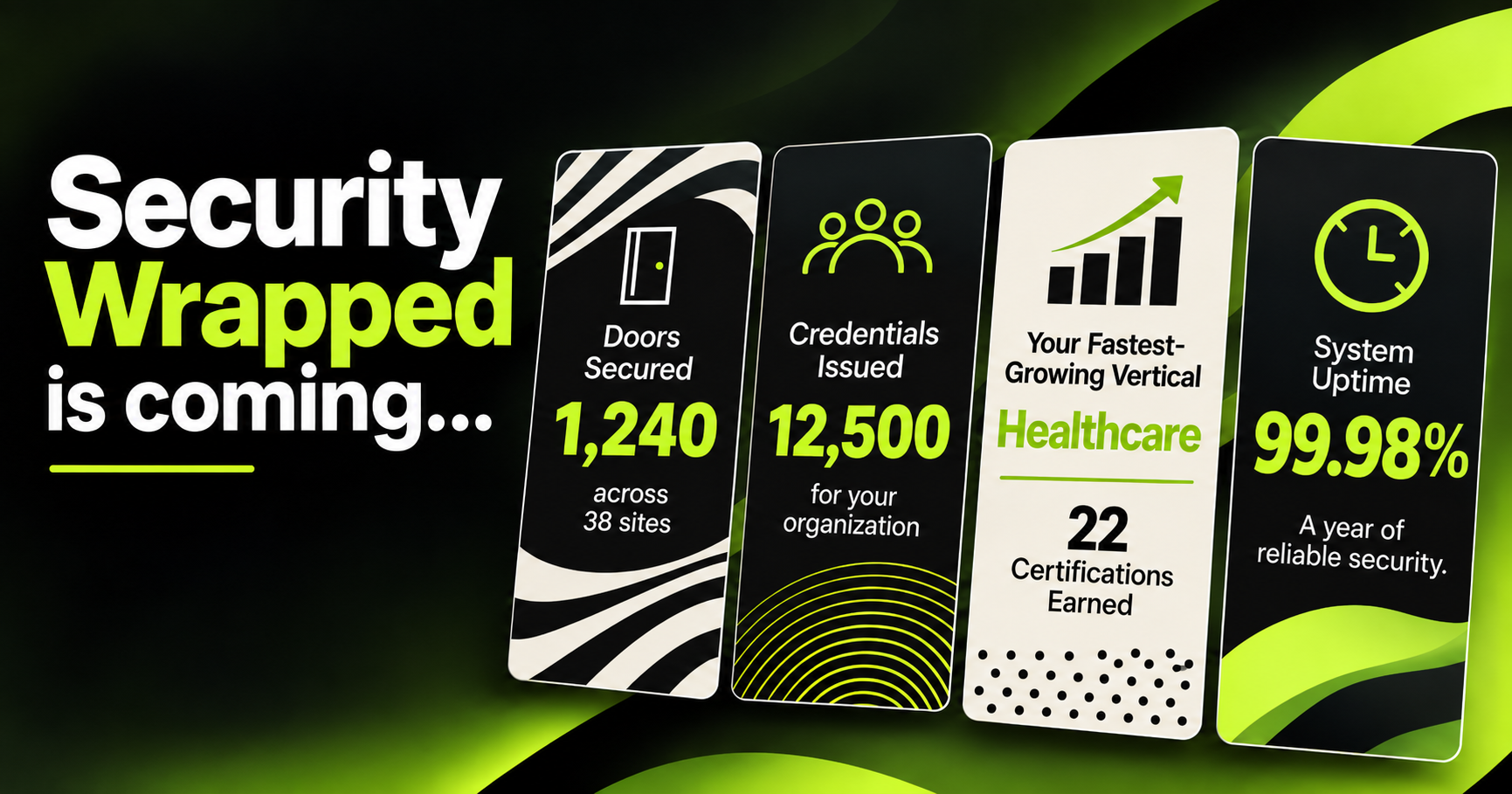
A security version should follow the same rule. An integrator recap is not a list of the manufacturer’s product launches. It reads more like this: you installed 1,240 readers across 38 sites this year, your fastest-growing vertical was healthcare, your biggest single project was a 14-building campus, and your team completed 22 certifications. For an end user on a cloud platform, it might be the number of doors secured, the hours of video kept, the number of new employees credentialed on day one, and the uptime their system held all year.
None of that is a sales message, and that is exactly why it works. A recap that celebrates the customer’s year earns attention that a year-end promotion never will.
03Design it to be shared
Wrapped really took off once Spotify made it easy to share, with ready-made graphics sized for social media. Sharing stopped being something users had to work at.
Integrators already post their work on LinkedIn because they’re proud of it. A manufacturer that hands every partner a finished, well-designed recap card with the integrator’s logo front and center gives them an easy post that makes their business look busy and capable. The manufacturer’s brand rides along on every one of those posts, in feeds the manufacturer could never reach on its own.
The same goes for end users. A facilities director who can show leadership a clean one-page summary of what the security program accomplished this year has a reason to forward it, and a reason to renew.
04Pair the personal recap with the big picture
Alongside every personal recap, Spotify publishes the global results: the top artist, top song, and top podcast worldwide. Listeners get their own story and the shared story in the same week, and the press gets a headline.
Manufacturers can do the same thing with aggregate numbers across their whole installed base. That could be total devices brought online this year, the verticals that grew fastest, how many partners earned certification, or how quickly customers adopted a new firmware release. A year-in-review like that is natural trade press material, gives the sales team something current to talk about in January, and positions the brand as the one with a real view of the market.
One caution is specific to our industry. Security data is sensitive in a way music data is not. Keep everything aggregated, never publish anything that could identify a site, a layout, or a customer, and make personal recaps opt-in or deliver them privately so the customer decides what gets shared. Handled that way, the recap itself shows that the brand takes data seriously.
05Same time, every year
Part of what makes Wrapped work is the anticipation. People know it’s coming; they start talking about it weeks ahead, and the launch reaches an audience already waiting for it.
A security brand earns that kind of anticipation by showing up at the same moment every year. Early December is a natural fit, since it lands before budget planning, before the holiday slowdown, and ahead of the trade show season that starts back up in the spring. Do it once, and it’s a nice touch. Do it three years in a row and partners start asking when theirs is coming.
06Give people what they came for
Wrapped has had its experiments. In 2024, Spotify leaned on new AI features, including a generated podcast-style summary, and plenty of users said they missed the straightforward stats. The 2025 edition brought back the numbers people wanted, like total minutes, top songs, and top genres, and it became the fastest launch in Wrapped’s history.
That’s a useful lesson for any recap program. Novelty is fine, but the core has to be the numbers the audience cares about most, presented clearly. For an integrator, that’s installs, sites, and growth. For an end user, it’s coverage, uptime, and what the system did for them. Start there, then add the fun.
07Measure it like a campaign
Spotify watches engagement and shares, and a security recap program deserves the same discipline. Track how many partners and customers open their recap, how many post it, how far those posts travel, and whether branded search picks up in December. Then look further down the funnel at partner portal logins, renewal rates among customers who received a recap, and whether integrators who got one placed more orders in the first quarter.
Those numbers turn a creative idea into a program the business will fund again next year.
The takeaway
Spotify didn’t need new data to build its biggest campaign. It needed to look at data it already had and ask how to make customers feel good about their year. Every security manufacturer with a cloud platform, a partner program, or a support team has the same opportunity, and Wrapped season is the perfect time to try it.
So pull the numbers, put the customer at the center, make it easy to share, and do it again next December. If you want help building your own year-end recap, that’s exactly the kind of work we do at Maize.