
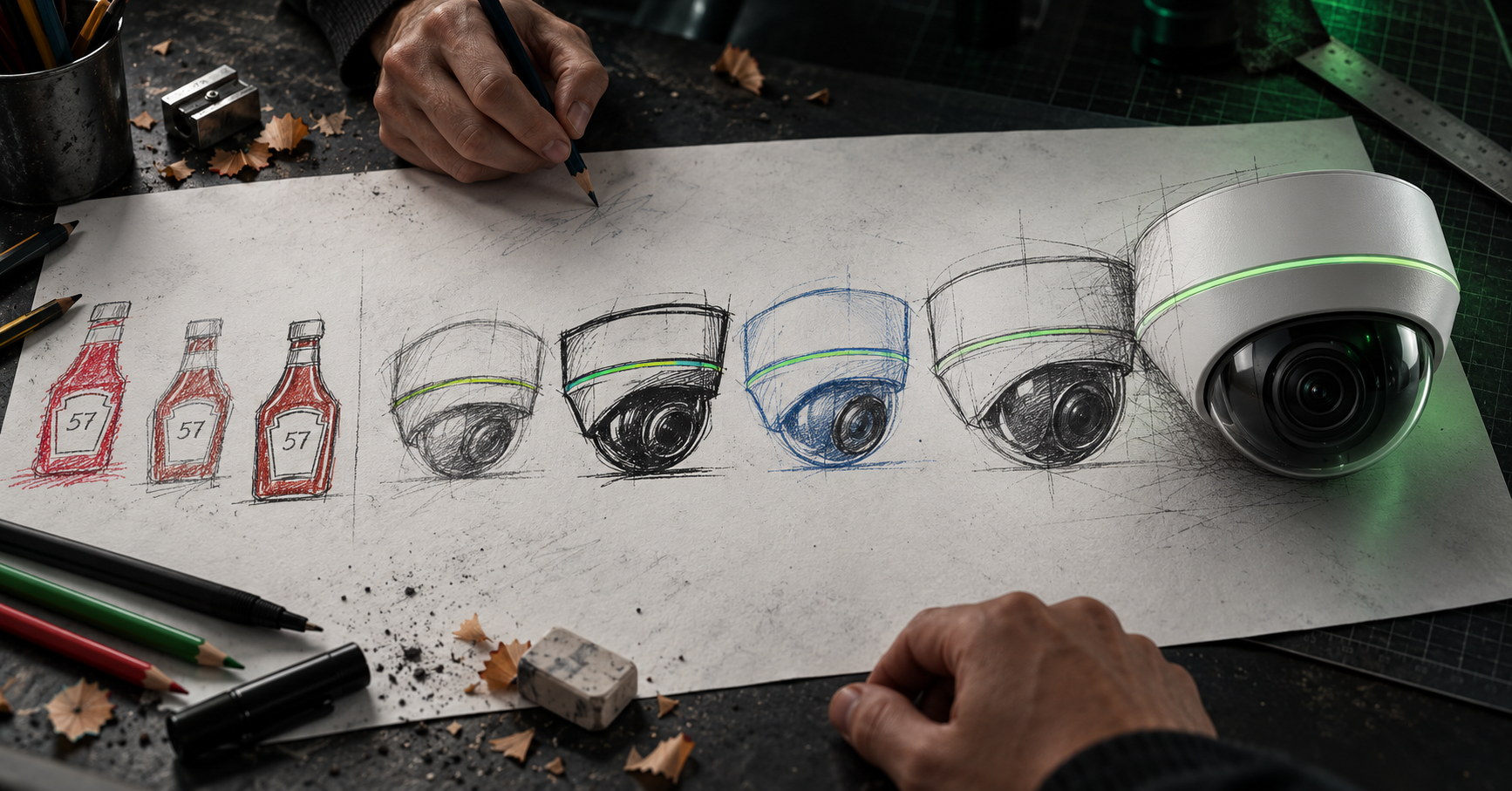
If you asked an integrator to draw a security camera, would they draw yours? A few years ago, Heinz ran one of the simplest experiments in modern advertising, and it is worth the attention of every security manufacturer that wants to own its category instead of just competing in it.
The brand had a problem that will sound familiar to anyone who has watched a legacy product line come under pressure. Heinz was the best-known ketchup in the world, but brand affinity scores were slipping, newer entrants were taking share, and more people were starting to see the brand as nostalgic rather than relevant. Heinz wanted to remind everyone that it was the definitive ketchup, but a brand cannot simply announce that it owns its category without sounding arrogant.
So Heinz and its agency, Rethink in Toronto, let the public say it for them. They ran an anonymous experiment across 18 countries on five continents, in person, on video calls, in classrooms and online, and asked people one thing: draw ketchup. Nobody was told who was asking. When the drawings came back, 97% of them were Heinz. People drew the glass bottle, the keystone-shaped label, the tomato, and even the "57"; some drawings were beautiful, while others were barely more than scribbles, but almost every one was unmistakably Heinz.
Heinz turned those drawings into a global campaign across social, digital, out-of-home, and TV, then printed the best Canadian submissions on custom bottle labels. The press picked it up worldwide, and the brand reported a 10% lift in ketchup sales. The idea later grew into a full platform called "It Has to Be Heinz," which won the Grand Prix for Creative Effectiveness at Cannes Lions in 2024.
There is a lot in that campaign that translates directly to security, and here is how we would put it to work.
01Find out what your market already pictures
The genius of the Heinz experiment is that it measured something brands usually guess at: the picture that forms in a buyer's head when they think about the category. Every security product category has that picture. When an integrator thinks about a dome camera, an access control reader, a video management interface, or an intrusion keypad, a specific shape, color or screen comes to mind, and it almost always belongs to someone.
You can run your own version of this test without a global agency budget. Put a sketch pad in your booth at ISC West or GSX and ask visiting integrators and end users to draw an access control reader in thirty seconds. Ask your dealer council to sketch a VMS screen from memory. Run a short anonymous survey that asks specifiers to describe the first camera that comes to mind for a parking structure. Whatever comes back is the most honest brand audit you will ever get, because nobody filters a quick sketch the way they filter a survey answer.
If the drawings look like your product, you have something valuable to amplify. If they look like a generic product or someone else's, you have learned exactly where to focus.
02Let your customers say what you can't
Heinz could never have run an ad that said "Heinz is ketchup" and gotten the same result, because a claim like that only lands when someone else makes it. The drawings worked because they came from real people who had no reason to flatter the brand.
Security manufacturers have the same opportunity with their own installed base. An integrator's sketch, a facilities director's offhand description of "the blue screen we use for everything," or a campus security team that refers to your reader by brand name instead of by category is far more persuasive than any line your marketing team could write. These moments already happen in the field every day, and the work is simply collecting them and putting them in front of the next buyer.
That can be as straightforward as a short video series of integrators sketching your products at a trade show, a page on your site that showcases how customers describe your platform in their own words, or a social campaign built around the shorthand your market already uses. The point is to make the market's own recognition the message.
03Protect the details that show up in the drawings
Look closely at what people drew in the Heinz experiment, and you will see the assets that did the work. The bottle shape, the keystone label, the tomato, and the "57" have been consistent for so long that people could reproduce them from memory, and that consistency is what made the campaign possible in the first place.
Security brands have distinctive assets too, even if they rarely think of them that way. The silhouette of a camera housing, the color of the LED ring on a reader, the accent color that runs through a software interface, the tone a panel makes when it arms, and the way a product name is written on the hardware are all things buyers can learn to recognize. The brands that benefit most are the ones that keep those details consistent across product generations, so that a product released this year still looks like it belongs to the same family as the one installed ten years ago.
The practical move is to identify which of your design elements are doing that job, document them, and make sure product, engineering, and marketing all treat them as brand assets rather than styling decisions that can change with every refresh.
04Turn one idea into a platform
Heinz did not stop at drawings. The brand followed up by typing "ketchup bottle" into an AI image generator and showing that the machine drew Heinz too. It ran another execution about restaurants refilling Heinz bottles with generic ketchup, which made the same point from a different angle. Each piece reinforced one idea, and together they became a platform strong enough to win at Cannes.
The AI version is especially relevant to security marketers right now, because buyers are increasingly starting their research in ChatGPT and other AI tools before they ever reach a search engine. Try asking an AI assistant to recommend a cloud access control system for a multi-site healthcare network, to describe what a typical VMS interface looks like, or to name the cameras most commonly specified for K-12 campuses. The brands that show up in those answers are the brands the market has taught the machine to associate with the category, and that is a modern version of the same test Heinz ran with colored pencils.
Once you know where you stand, you can build a series around it. A trade show sketch wall, an AI answer audit, a customer video series, and a dealer contest can all carry the same message: when buyers think of the category, they think of you.
05Measure recognition like a business result
What separated the Heinz campaign from a clever stunt is that it was tied to numbers the business cared about. The 97% recognition figure gave the creative its proof point, and the 10% sales lift gave leadership a reason to keep investing.
Security marketing can hold itself to the same standard. Track how often your brand name shows up in integrator and specifier conversations, how frequently your products are written into specifications by name, how your branded search volume moves after a campaign, and how often AI tools mention you when asked category questions. Run the same drawing or description test once a year so you can see whether recognition is growing. These are leading indicators of what every manufacturer actually wants: being the default choice before a competitive bid even starts.
The takeaway
Heinz proved that the strongest position a brand can hold is not the one it claims but the one its market draws from memory. In a business built on specifications, approved product lists and long relationships with integrators, that kind of recognition is worth more in security than it is in ketchup.
So hand someone a pen and ask them to draw your category, and then build your marketing around whatever they put on the page. If you want help running that test or turning the results into a campaign, our services page shows how we approach brand work for security manufacturers.