
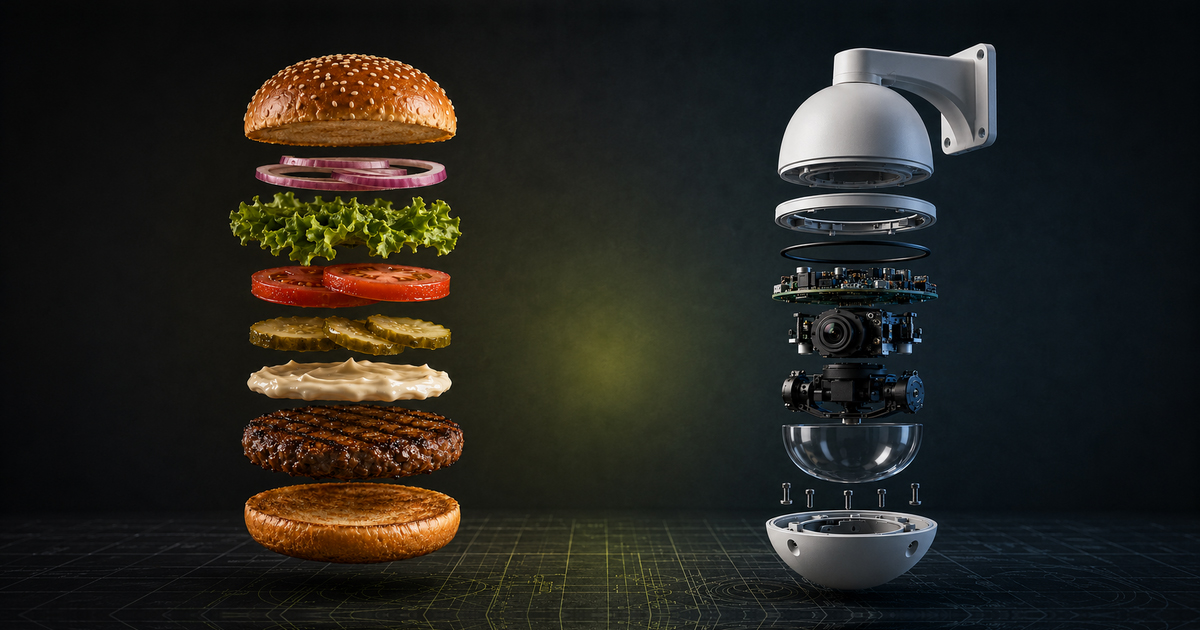
Burger King spent most of the last decade losing. Aging restaurants, menu items its own crews couldn’t execute, franchise groups filing for bankruptcy, hundreds of closed locations. This month it reported an 8.5% jump in U.S. same-store sales, beating McDonald’s by the widest margin in at least two years while Wendy’s fell 7%. It reclaimed the No. 2 spot among U.S. burger chains.
According to The Wall Street Journal, it did this without outspending anyone. McDonald’s still runs roughly five times the domestic sales and a billion-dollar ad budget.
The interesting thing isn’t that Burger King recovered. It’s the order it did things in.
Before Restaurant Brands spent on upgrading restaurants and expanding marketing, it fixed the Whopper. Better bun. New mayonnaise. A box to hold heat. A corporate chef, Amy Alarcon, was brought in to own the product itself. Only then did the money go to kiosks, digital menu boards, and a bigger marketing push.
Same three moves, in the same order, translate cleanly to a security manufacturer selling through a dealer channel. Here’s what each one actually looks like when you run it.
01Put a single owner on the flagship, and define “better” in installer hours
Burger King’s fix wasn’t a new product. It was the Whopper, the thing already in most of its orders, taken seriously again. And it had a name attached: a chef whose job was the sandwich itself, not the category, not the calendar.
The manufacturer version of this is less appetizing and more important. Your flagship line is in most of your quotes and most of your installed base. It is also, in most cases, the product nobody currently owns. Product management owns the roadmap. Engineering owns the release. Marketing owns the launch. Nobody owns whether the thing is good.
Name that person. Then give them a definition of “better” that isn’t a feature.
The most useful one in this industry is installed labor. How many hours does a two-tech crew need to get a panel, a reader, or a camera from box to commissioned and handed over? Not in your lab. On a retrofit, in a building with the wiring you actually find. Measure it, then measure the two competitors you lose to most. If they’re materially faster, that gap is your entire competitive problem, and no amount of positioning can close it.
The specifics differ by category. What slows an access control installation is rarely what slows a video surveillance deployment, so get the number for the line you actually lead with rather than an average across the catalog.
The fixes that come out of this exercise are almost never ready for launch. Firmware that provisions without a laptop. A mounting bracket that doesn’t need a third hand. Default configurations that match how integrators actually deploy, rather than how the spec sheet describes it. Documentation a tech can follow on a phone at the top of a ladder.
None of that goes in a press release. All of it shows up in the next bid.
02Pick one offer and leave it alone long enough to be memorized
Burger King standardized on two items for $5, or three for $7, and stopped changing it. Its U.S. president told the Journal the consistency is the point: customers can remember it.
Its competitors did the opposite. McDonald’s ran $5 meal deals, then buy-one-get-one-for-a-dollar, then cheaper combos, then an under-$3 menu, and executives later acknowledged too few franchisees ran the under-$3 menu as intended. Wendy’s added $4, $6, and $8 Biggie Bag tiers, and its new CEO has told franchisees the promotions need to land better. Both chains are now publicly rethinking how they do deals.
Channel programs have the same failure mode. Q1 SPIFF. Q2 bundle. A mid-year rebate tier restructure. A fall promo with different qualifying SKUs than the spring one. New MDF rules. Each change is defensible on its own. Together they produce a program that your own regional managers can’t explain from memory.
That’s the bar, and it’s worth testing literally. Your offer has to survive being repeated four times: from you, to the integrator’s principal, to the estimator building the bid, to the end user in the room. Every layer of qualifying conditions is a layer that gets dropped somewhere in that chain.
Practically: pick the one commercial promise you want associated with your brand, state it in a sentence, and commit to it for four quarters minimum. Resist the quarterly urge to add a wrinkle. Consistency compounds only if you let it run long enough.
03Make someone senior genuinely reachable, and treat it as research
Tom Curtis, Burger King’s U.S. president, appears in the chain’s own social videos telling customers to call him directly with complaints. The company says he has personally taken 3,300 calls.
The obvious read is that it’s good for trust. The more useful takeaway is that it’s the cheapest product research operating within that company. You cannot handle 3,000 phone calls and still be confused about what’s wrong with your product.
That’s what makes this move worth copying, and it’s why it belongs in a turnaround rather than in a brand campaign. A published, answered line from someone with real authority does two jobs at once: it tells the channel you’re serious, and it feeds Move 1 with the unfiltered version of why you’re losing bids.
The unfiltered part matters. Physical security is a channel business, and the reason you lost a bid gets compressed as it travels back up through the distribution chain. It almost always arrives as “price.” Price is what people say when the real answer takes too long to explain. A direct line skips the compression.
This is the cheapest of the three moves, and the one most manufacturers skip, because it produces no asset. There’s no deliverable. There’s a leader who is findable, and a channel that notices.
The sequence is the point
A visible executive without a fixed product just puts a name on the complaint. A simplified value story around a flagship that underdelivers distributes the bad news faster. And marketing spend on either of those buys you a larger audience for a product experience that’s losing on its merits.
Burger King ran it in order: fix the core, simplify the offer, then show up and talk about it. The chain’s president was direct about what’s driving the numbers now, and it wasn’t a new category or a bigger ad budget. It was consistent value and commitment to the flagship.
That’s a slower plan than a rebrand, and a less exciting one than a launch. It’s also the one that worked while two much larger competitors were still reaching for the deal menu.
Source: Heather Haddon, “How Burger King Revamped Its Whopper and Overtook Wendy’s,” The Wall Street Journal, Aug. 16, 2026.