
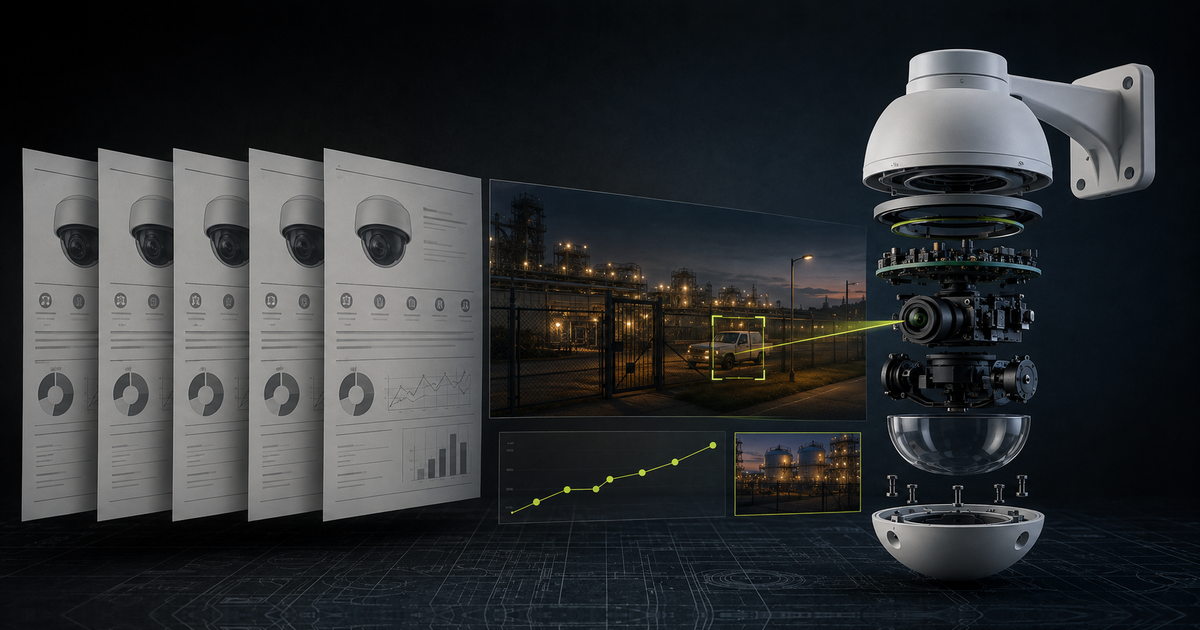
Pull up the product pages of five video surveillance manufacturers and try to tell them apart. Every one of them now claims AI analytics, exceptional low-light performance, flexible cloud options and cybersecurity hardening. The features have converged, the language has converged with them, and the spec sheet has quietly stopped being a differentiator. That is not a product problem. It is a marketing problem, and it has a known solution.
When claims converge, buyers fall back on trust, and trust in this industry is built from evidence: who uses the product, what happened when they did, and who besides the vendor is willing to say so. Marketing a surveillance product in 2026 is therefore mostly the discipline of manufacturing proof and putting it where integrators, consultants and end users already look. Everything else is decoration.
01Proof beats promises
The strongest asset a surveillance brand can own is a documented deployment with a named customer and real results, because it does work no ad can do: the trade press covers it, channel partners retell it, and buyers cite it internally to justify the spec. We have built programs on exactly this foundation, and two of them are public if you want to see the mechanics. Our work with FLIR is documented in the FLIR case study, and the Seagate SkyHawk program in the SkyHawk case study. Different products, same underlying move: turn a real customer outcome into a story the industry retells for you.
When every spec sheet reads the same, the vendor with the best evidence wins the tie.
02Teach the category, not the camera
The second differentiator is education. Surveillance buying decisions run through people who have to justify them: the consultant defending a spec, the integrator explaining a recommendation, the security director defending a budget line. Brands that arm those people with genuinely useful category knowledge, honest comparisons, deployment guides and design thinking earn a place in the conversation that feature advertising cannot buy. This is slower than demand gen and it compounds, which is precisely why so few vendors do it and why it works for the ones that do.
03Be visible where the industry actually looks
The surveillance industry has a small, knowable media surface: a handful of trade outlets, a few conferences that matter, and a professional community that mostly reads the same things. That makes earned media unusually efficient here, and it makes consistency matter more than budget. A steady presence in the trade press, a point of view that shows up repeatedly, and case studies that give editors something concrete to cover will outperform sporadic ad bursts at several times the spend. We lay out how we build this kind of program on our video surveillance marketing page.
None of this is complicated, but all of it is work, which is the honest reason most surveillance marketing defaults to another round of feature ads. The brands winning attention in this category right now are the ones that decided proof was worth manufacturing deliberately.