
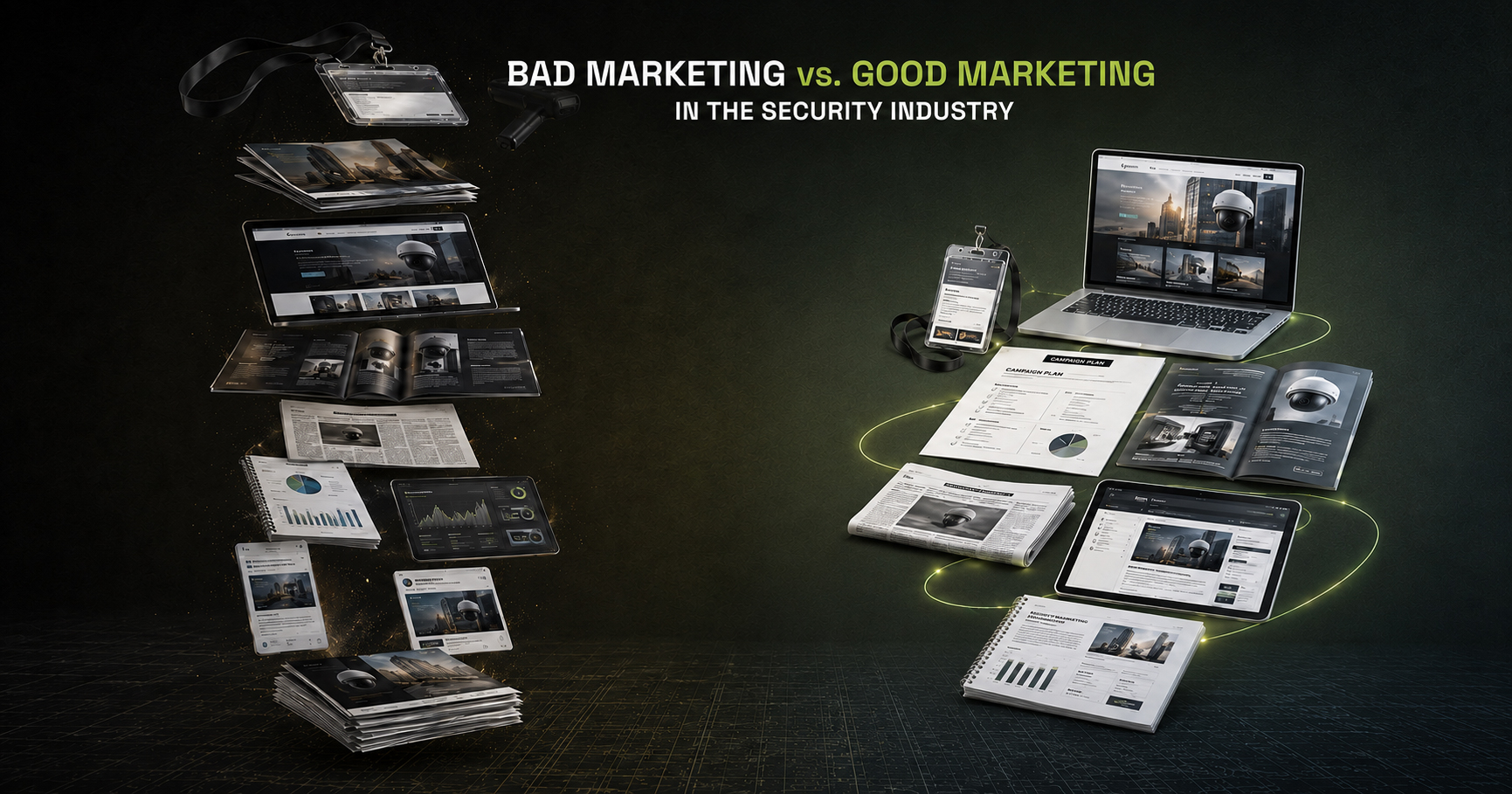
Every marketing team in this industry can produce a busy month. Posts published, show scanned, newsletter sent, impressions up and to the right. What almost none of that tells you is whether a single consultant changed a basis-of-design, or whether one integrator moved you up their line card.
The difference between bad marketing and good marketing in security is not effort. Bad marketing is frequently the harder-working of the two. The difference is what the work is pointed at.
Security products are specified, bid, installed and lived with for a decade, by a channel that has watched a hundred manufacturers say the same eight things. Marketing that ignores that reality can stay extremely busy and still never enter the room where the decision is made. It is also why sequence matters as much as spend — something we pulled apart in the Whopper playbook, where a turnaround worked because the moves happened in the right order.
Here is the translation, category by category.
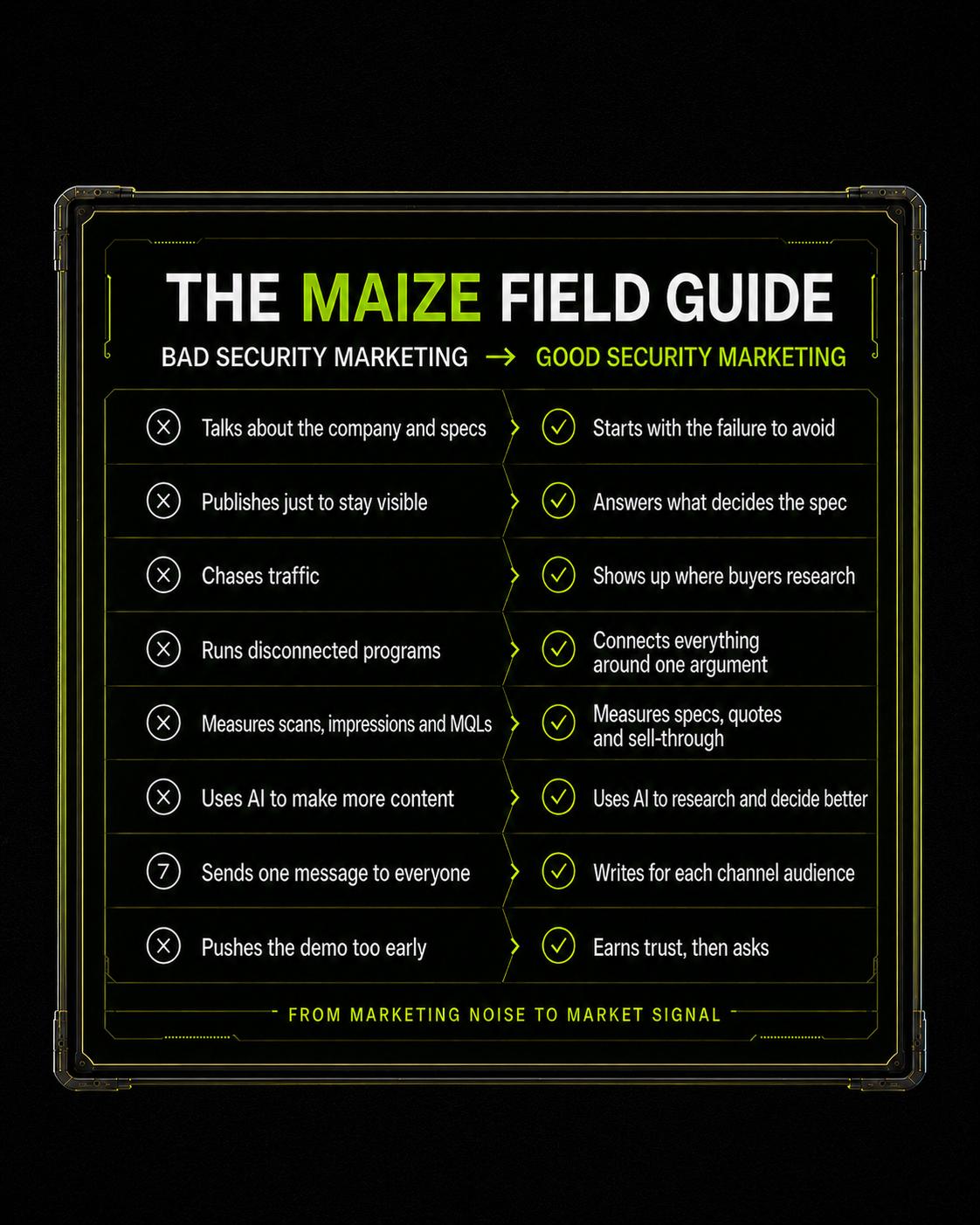
01Bad marketing talks about the product. Good marketing starts with the failure.
Nobody buys a door controller. They buy the certainty that the badge works on the first swipe at 6am, that the audit log holds up, and that nobody gets a call at 2am. Nobody buys a camera. They buy the confidence that the plate is readable when the footage matters.
Most manufacturer marketing in this category opens with the company: founded in, trusted by, leading provider of. It is comfortable to write and it tells the buyer nothing they can act on. The strongest opening line in security marketing is not what your product is, it is the specific failure your product makes unlikely.
That reframe is usually sitting in a deployment nobody has written up yet. FLIR had thermal cameras securing a six-mile airport perimeter and almost no one in the market knew it, and the story that changed that was not about the cameras. It was about the problem an airport had at the fence line. The full program is here, including how we got the end user to sign the approval form, which is the part most manufacturers assume is impossible.
02Bad marketing publishes to stay visible. Good marketing answers the questions that decide the spec.
There is a real list of questions being typed into search bars, into vendor portals, and increasingly into AI assistants, by the people who decide what gets installed. Will it integrate with the VMS the customer already runs. What is the actual ONVIF profile support. What is the licensing model in year three. What happens to the system when the network drops.
Content built to fill a calendar answers none of these. Content built around them does three jobs at once: it ranks, it gets cited when an integrator asks an AI assistant to shortlist products, and it gets forwarded internally by the one person championing you.
This is what the shift from search optimization to answer-based discovery actually looks like in this industry, and it lands hardest in categories where the datasheets have converged — the problem we worked through in marketing video surveillance when every spec sheet reads the same.
03Bad marketing runs channels. Good marketing runs a system.
The common failure is not a weak channel. It is five decent channels making five different arguments. The show booth says one thing, the PR agency says another, the website says a third, the distributor portal is eighteen months out of date, and sales opens with something they wrote themselves because none of the above was usable.
A growth system means the same argument, proved the same way, everywhere the buyer touches you, with the CRM wired in so you can see which touch actually moved a project. In practice this is less about tooling than about a single owner of the argument, which is the whole reason we keep strategy and execution under one roof. When the case study, the booth, the byline and the sales deck all lead with the same proof point, each one makes the others stronger.
04Bad marketing counts activity. Good marketing counts specs, quotes and sell-through.
Booth scans are the MQL of the security industry: an easy number, mostly meaningless, and defensible right up until someone asks what it produced.
The metrics that matter in a channel business are harder to gather and worth the trouble. How many basis-of-design specs name you this quarter. How many projects registered. How many quotes moved through distribution. What sold through, not just what shipped in.
Editorial is measurable this way too, which surprises people. Seagate’s surveillance drives were inside everyone else’s systems with no voice in the security trades, and twenty-three months of ghostwritten editorial, roundtables and award submissions produced 46 placements and a lead number we were willing to publish.
You will not get clean attribution in a market where a spec written in March becomes a purchase order in November. You do not need clean attribution. You need to be able to answer, in a room with the CFO, what marketing changed about the pipeline. Most programs in this industry cannot, and that is why their budgets are the first thing cut.
05Bad marketing uses AI to make more. Good marketing uses AI to know more.
The obvious use of AI is volume, and volume is the one thing this industry does not need more of. There are already more undifferentiated product blogs about low-light performance than anyone will ever read.
The valuable use is upstream. Reading three years of competitor spec sheets to find the claim nobody has made. Synthesizing every support ticket into the three objections your channel actually raises. Drafting the first pass of an RFP response so a human spends their time on the parts that win it. Checking how AI assistants currently describe your product against your competitors, which is now a genuine discovery channel and a strange thing to be blind to.
AI is worth far more as a research and decision tool here than as a content machine.
06Bad marketing sends one message. Good marketing writes for each link in the chain.
Between your factory and the end user sit a consultant, a distributor, an integrator and a facilities or security director, and they want incompatible things. The consultant wants a product they can defend in a spec. The distributor wants turns. The integrator wants margin, training and no callbacks. The end user wants the thing to work and to talk to the systems they already own.
One message for all four is a message for none of them. The programs that work maintain genuinely different arguments for each link, using the same proof — the structure we lay out for access control marketing and for video surveillance, and in more depth in what actually moves integrators and specifiers.
It is also why partner enablement is marketing and not sales support. When Seagate’s Lyve organization sold edge data into energy, media and defense, the partner programs were the campaign.
Then, and only then, the ask
The last pair on the list is the one that governs the other seven. Security buyers are choosing a decade-long dependency from a field where every brochure promises open architecture, cyber hardening and AI analytics. When the feature language converges, trust is the tiebreaker, and trust in this industry is built from proof: named customers, real numbers, and stories a skeptical integrator can verify with a phone call. That was the core of the program we built with dormakaba around the first Apple Wallet room keys on the Las Vegas Strip — approval chain and all.
The pattern behind all eight pairs is the same. Bad marketing optimizes for being seen by everyone. Good marketing optimizes for being relevant when a specifier is researching, trusted when an integrator is comparing, and easy to choose when a project is finally funded.
The first is measured in impressions. The second is measured in specs.
That is the whole distinction, and it is why we publish the work rather than describe it. Judge us the way your customers judge you.